
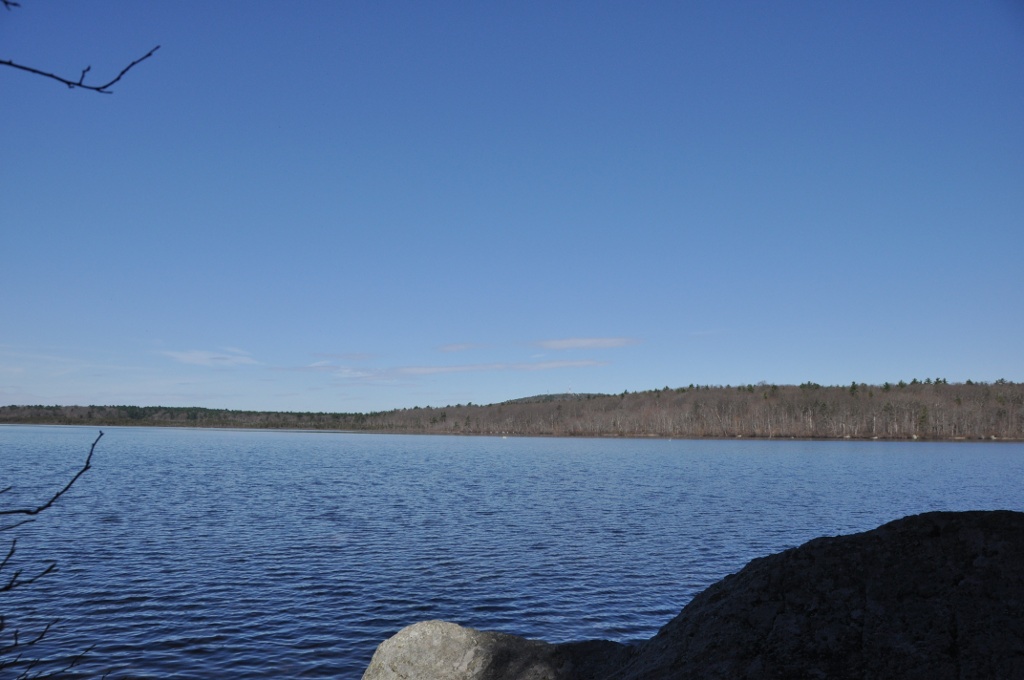
Ponkapoag Pond with Great Blue Hill. Photo: Magicpiano / Wikimedia Commons, CC BY-SA 4.0
Not for nuthin'…. But….. how many times have you driven down 93 past the Blue Hills, headed for the Cape, and never once thought about whose name is on your license plate?
The Commonwealth of Massachusetts took its name from a people: the Massachusett. And here's the part a lot of us never got taught. They never went anywhere. The Massachusett Tribe at Ponkapoag is still right here, and when Sagamore Faries Gray spoke at the State House in May 2025, he put it about as plain as it gets: "We are Still Here."
The people of the great hill
The state's Department of Conservation and Recreation notes the name, often given as "people of the great hills," may refer to the Blue Hills, the same ones you see from Ponkapoag Pond. The tribe describes itself as descended from the Neponset band of the Massachusett, led in the early 1600s by the great sachem Chickataubut. His chief seat was at Neponset (today's Milton and Dorchester), and he summered at Moswetuset Hummock in Quincy, which the tribe notes is still there, untouched after nearly 400 years.
Then the English showed up in numbers. Per the tribe's history, the Neponset families were pushed off their planting fields and shoreline and "forced over the blue hills" to Ponkapoag. The missionary John Eliot, who had begun preaching to the Neponset people in 1646, petitioned Dorchester for them. On December 7, 1657, the town voted to lay out a plantation there "not to exceed 6,000 acres." That made Ponkapoag the second "praying town" after Natick. Most of it is in today's Canton.
Deer Island, and after
When King Philip's War broke out in 1675, the Ponkapoag people weren't the ones fighting. The tribe's own account, drawing on eyewitness Daniel Gookin, says the colony removed the whole town to Deer Island anyway. The National Park Service says 500 to 1,100 "Christianized" Native people, mostly women and children, were held there that winter, and starvation and cold killed many. Gookin wrote that "the Island was bleak and cold, their wigwams poor and mean, their clothes few and thin." The survivors were released in the spring of 1676.
Then the land went, piece by piece. The tribe's timeline shows the 6,000 acres whittled to about 710 by 1760, with appointed "guardians" selling off the rest, the last parcels in 1827. In 1857 the guardians called the tribe "nearly extinct." In 1869 came the state's Enfranchisement Act, which made Native people citizens and, in the tribe's words, terminated Indian tribes. And get this: a 1675 law barring Native people from walking in Boston unaccompanied wasn't repealed until 2004.
Close to home for us North Shore folks
The tribe's website lists Pawtucket (now Lynn) as the seat of Nanepashemet (they spell it Nanapashamet), a Massachusett sachem whose territory, it says, ran from the Piscataqua down to the Charles, and puts his son Sagamore Wenepoykin's seat in what's now Salem. In 2023 the tribe shared photos from the unveiling of a new portrait of Nanepashemet and his wife, remembered as the Squaw Sachem, for the Salem City Council chambers. Artist Chris Pappan painted it with tribal members, using present-day tribal families as reference. In November 2024, Cambridge's City Council voted to recognize the Massachusett as the city's original inhabitants and to plan a memorial honoring her; a tribal council member suggested calling her "Sunksqa."
Where things stand today
Let's get this right. The Massachusett Tribe at Ponkapoag is not federally recognized (it isn't on the Bureau of Indian Affairs' January 2026 list), and it's not one of the four tribes the Commonwealth recognizes by executive order: the Mashpee Wampanoag, the Aquinnah Wampanoag, the Hassanamisco Nipmuc, and, since November 2024, the Herring Pond Wampanoag. The tribe named the state, and it still has no formal standing with it. Chew on that one.
Recognition or not, they've been busy. In 2021 Boston's Mayor Kim Janey recognized the tribe while making Indigenous Peoples Day official, and the Harvard Club of Boston permanently raised their flag. In 2022 they and Nipmuc partners burned out a traditional mishoon (dugout canoe) at Charlestown's Little Mystic boat slip, reportedly the first joint Nipmuc-Massachusett mishoon burning in Boston's postcolonial history. East Cambridge's First through Eighth Street signs now also appear in the Massachusett language. In September 2025 the tribe co-hosted an arts and crafts fair with the North American Indian Center of Boston at Prowse Farm on Blue Hill River Road in Canton. And on Sunday, October 4, the tribe's vice president, Thomas "Spirit Tree" Green, is expected at the opening of Malden River Works Park.
MOAM's take
We name our towns, rivers, and whole state after these people, then treat them like a chapter in a history book. They're our neighbors. So spell it right: Massachusett, no "s" on the end. Read their history in their own words at massachusetttribe.org. Show up when they host something. And when the Mass Indigenous Legislative Agenda bills come around (the mascot ban, a statewide Indigenous Peoples Day, Native history in the schools), call your rep. It's not a big ask. As Sagamore Gray said, they're asking "to be treated like every other race is treated."
Full disclosure: my novel, The Wing, is narrated by Wenepoykin, Nanepashemet's last surviving son. Writing it sent me down this road. But the tribe's own voices come first.
Next time you're out at Ponkapoag Pond, remember who was there first, and who's still here.
MOAM Out
Sources
- The Massachusett Tribe at Ponkapoag, official website (home, "The Tribe," "We Are The Massachusett"): massachusetttribe.org/, massachusetttribe.org/the-tribe, massachusetttribe.org/we-are-the-massachusett
- Massachusett Tribe, "The Removal of the Neponsets to Ponkapoag"
- Massachusett Tribe, "Life of the Indigenous Massachusett at Ponkapoag Plantation" (quotes Daniel Gookin)
- Massachusett Tribe, "Chronological Listing of Historically Important Events at Ponkapoag Plantation"
- Massachusett Tribe, "Portrait of Nanepashemet and Squaw Sachem in Salem" (Jan. 10, 2023)
- Massachusett Tribe, "Boston Mayor Kim Janey declares Indigenous People's Day and recognizes the Massachusett Tribe" (Oct. 11, 2021)
- Massachusett Tribe, "Harvard Club of Boston raises Massachusett Tribe's Flag" (Oct. 11, 2021)
- Cultural Survival, "Massachusetts Indigenous Legislative Agenda Advances" (May 19, 2025; Sagamore Faries Gray's remarks)
- Mass. DCR, "Ponkapoag Pond Master Plan and Fisherman's Cove Improvements"
- National Park Service, "Deer Island"
- National Park Service, Boston Harbor Islands, "Indigenous History and Ways of Knowing"
- WBUR, "Local Indigenous tribes gather to build community and learn an ancient skill" (Nov. 15, 2022)
- Federal Register, BIA list of federally recognized tribes (Jan. 30, 2026)
- Mass.gov, Executive Order No. 126 (Massachusetts Native Americans)
- Mass.gov, Executive Order No. 637 (Recognizing the Herring Pond Wampanoag Tribe)
- The Harvard Crimson, "City Council Acknowledges Massachusett Tribe as 'Original Inhabitants' of Cambridge" (Nov. 5, 2024)
- Cambridge Historical Commission memo to City Manager, CMA 2025 #31 (Feb. 24 / Mar. 3, 2025; "Sunksqa" note)
- City of Cambridge, "Native Spaces" (Massachusett-language street signs)
- PowWows.com calendar, "Gathering of the People Arts & Crafts Fair 2025" (Sept. 13, 2025, Prowse Farm, Canton)
- Malden Patch, "Malden River Works Park Set To Open After Years Of Planning" (Sept. 25, 2026)


No comments:
Post a Comment